 Skip to content

Page builders give WordPress users complete freedom over the design of their websites, without touching code.
For many site owners, a good page builder has replaced the need for expensive premium themes. You’re no longer limited by what your theme allows.
But the page builder market has changed a lot. Divi was rebuilt from scratch, Elementor added AI and a new editor, and a new wave of builders now focuses on clean code and AI-assisted workflows.
In this article, I’ll walk you through the best drag-and-drop page builders for WordPress in 2026. I’ll cover the interface, templates, key features, and current pricing of each one, so you can pick the right builder for your site.
But first, let’s look at a few things you should consider before choosing one.
Things To Consider Before Choosing A Page Builder
Not all page builders are the same. Some let you design your entire website, including headers, footers, and templates. Others only handle the content area of your pages.
Here are the factors that matter most:
Compatibility
Your page builder should work with your WordPress theme and your plugins. This matters most for plugins that connect to third-party services, like email marketing tools.
If you run an online store, check that the builder works well with WooCommerce.
Responsiveness
Most of your visitors are probably on mobile, so your page builder must be responsive.
Almost every builder today offers responsive support. The better ones also offer responsive editing, where you can preview and adjust your design for tablets and phones right inside the editor.
SEO-Friendly
This factor is often overlooked. A page builder should produce clean, well-structured pages that search engines can read easily.
Speed also falls under SEO. Some builders add a lot of extra code to every page, which slows your site down. Since speed affects rankings, lighter output is always better.
Ease of Use
The interface should be simple enough that you can use it effectively without a learning curve that eats up weeks.
Most builders today are “what you see is what you get” (WYSIWYG) editors. You design on the live page and see changes instantly, without switching to a preview.
Support & Documentation
A page builder is only as good as the help behind it. Look for clear documentation, responsive support, and an active community where you can find answers quickly.
Now that we’ve covered what to look for, let’s get to the list.
Best WordPress Page Builder Plugins
Here’s a quick comparison of all the page builders on this list:
Page Builder | Best For | Free Version | Paid Plans Start At |
|---|---|---|---|
Elementor | Most users, all-round site building | Yes | $60/year |
Divi | Unlimited sites on a budget | No | $89/year or $249 lifetime |
Beaver Builder | Agencies and stable client sites | Yes (Lite) | $89/year |
CrocoBuilder | Developers and AI-assisted workflows | No | $79/year |
Kirki | Freeform, design-tool style building | Yes | $59/year |
Ultimate Blocks | Staying in the block editor | Yes | $39/year |
Thrive Architect | Conversion-focused landing pages | No | $99 first year |
Visual Composer | Beginners who want a simple builder | Yes | $49/year |
Themify Builder | Theme and plugin bundle value | Yes | $69/year |
WPBakery | Sites with themes that bundle it | No | $82 one-time |
SiteOrigin Page Builder | Lightweight builds on a tight budget | Yes | $29/year |
I’ll go in-depth on each page builder, showing you the interface, templates, and key features you need to know.
By the end of the article, you’ll be able to choose the right page builder for your WordPress site.
Let’s get started.
1. Elementor
Elementor is still the most popular WordPress page builder by a wide margin. The company says it powers more than 22 million websites.
Interface
Elementor is a real-time drag-and-drop builder. You design on the page and see every change as you make it.
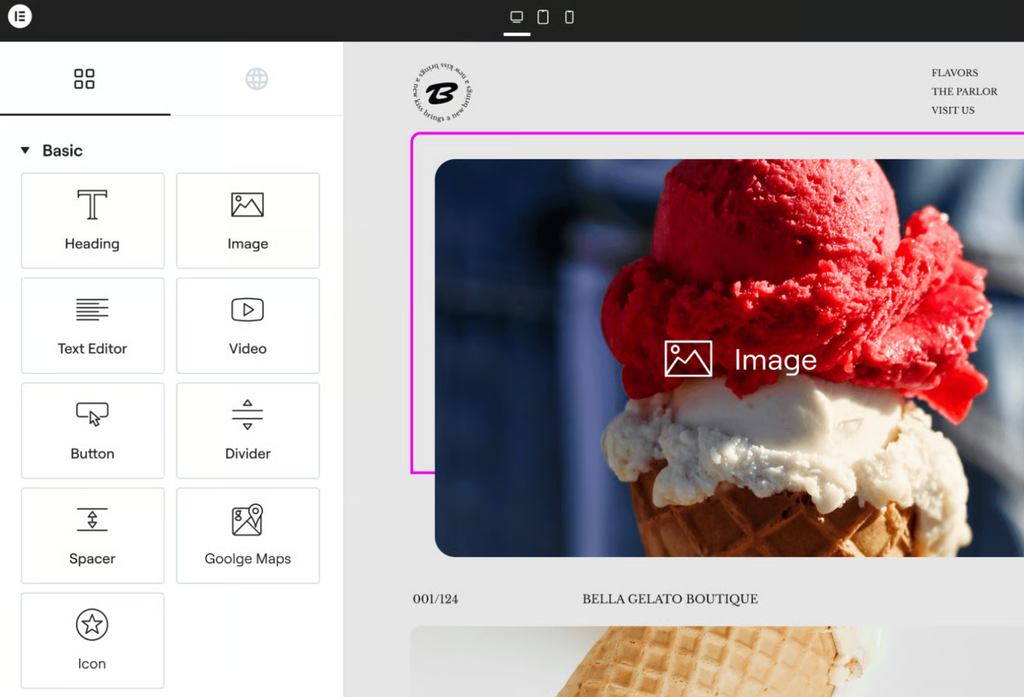
Widgets sit in the left panel, and you drag them onto the page. Click any element to change its content, style, or advanced settings.
Elementor’s newer editor (Editor V4) produces leaner page code than older versions, which helps with speed.
Widgets & Templates
The free version includes a solid set of basic widgets, such as headings, images, buttons, tabs, accordions, and testimonials. Pro plans add up to 85 premium widgets, including forms, sliders, pricing tables, and a full set of WooCommerce widgets.
You also get a large library of pre-designed templates and full website kits that you can import with one click and customize.
Elementor also has the biggest ecosystem of third-party add-ons of any builder, so you can extend it almost endlessly.
Options
Elementor isn’t just for single pages. With the Theme Builder, you can design your header, footer, blog posts, archives, and every other part of your site.
It includes responsive editing with custom breakpoints, a popup builder, a form builder, and a WooCommerce builder for designing product, cart, and checkout pages.
Elementor has also leaned into AI. Its AI tools can generate text, images, code, and full page layouts, and Elementor now offers an MCP connection so AI assistants like Claude can work with your site.
Key Features
Here are some of Elementor’s most notable features:
- Theme Builder for headers, footers, and templates
- Global colors and typography
- Dynamic content from custom fields
- Popup Builder and Form Builder
- WooCommerce Builder
- Motion and scrolling effects
- Custom CSS and custom code
- AI generation for text, images, code, and layouts
- Cloud templates you can reuse across sites
Pricing
A big reason for Elementor’s success is its free version, which is powerful enough to build good-looking pages on its own.
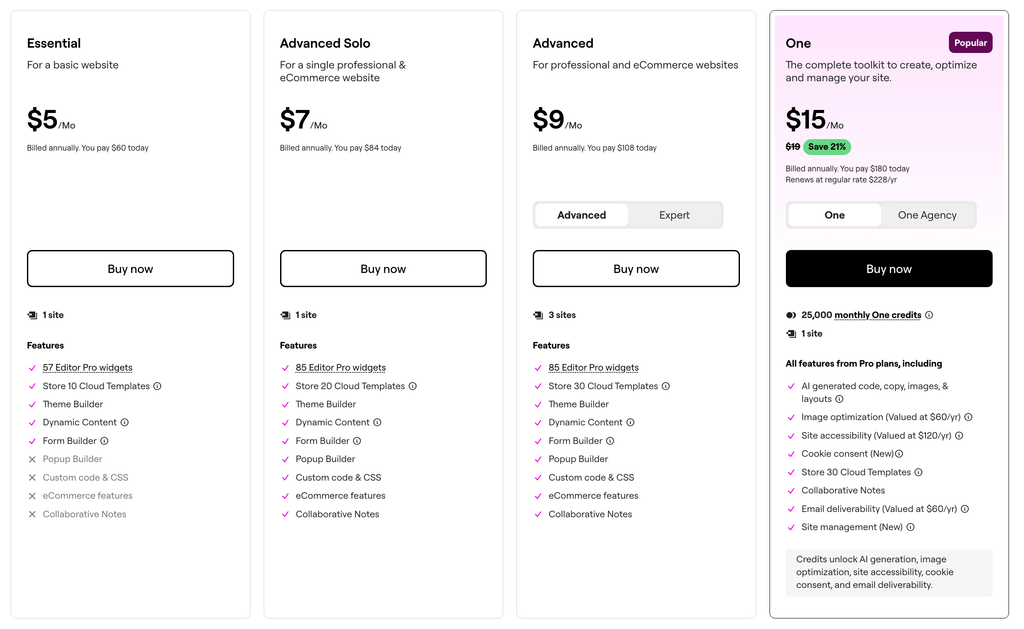
Paid plans are billed yearly:
- Essential ($60/year, 1 site): Theme Builder and 57 Pro widgets, but no popup builder, custom code, or eCommerce features.
- Advanced Solo ($84/year, 1 site): All 85 Pro widgets plus popups, custom code, and WooCommerce features.
- Advanced ($108/year, 3 sites).
- Expert ($204/year, 25 sites).
There’s also Elementor One at $228/year for one site ($180 for the first year). It bundles the Pro editor with AI credits, image optimization, accessibility tools, and email deliverability. One Agency costs $540/year ($432 for the first year) for unlimited sites.
If you’re building one site and want the full feature set, Advanced Solo is the plan I’d recommend.
2. Divi
Divi is the flagship theme and page builder from Elegant Themes. In February 2026, Divi 5 launched as a complete rewrite of the builder, making it noticeably faster and more modern than earlier versions.
Interface
Like Elementor, Divi is a real-time visual builder. You click on any element on the page to edit it, and changes appear instantly.
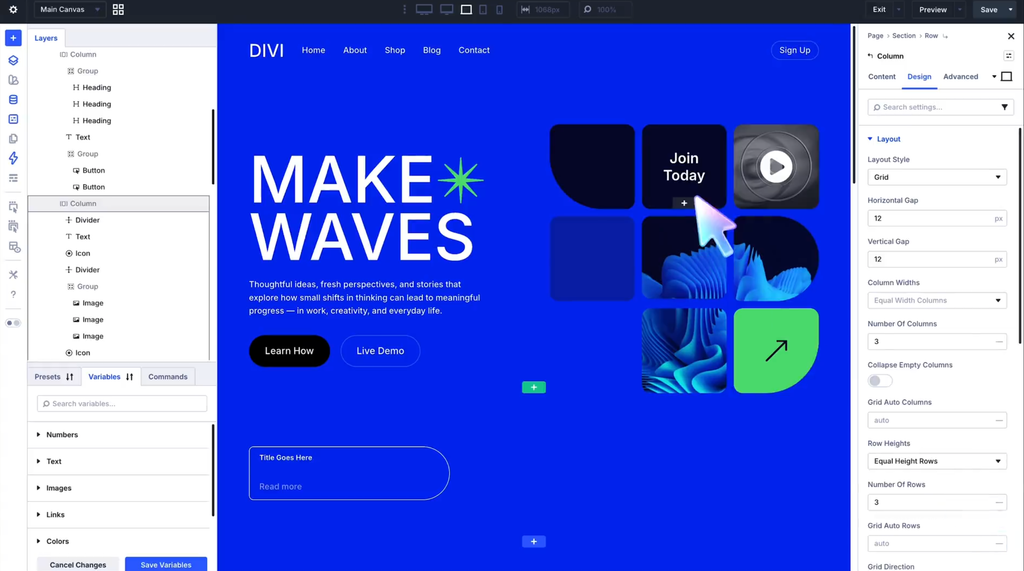
Divi 5 rebuilt the editor from the ground up. It feels much snappier than Divi 4, and it adds a more flexible layout system.
Widgets & Templates
Divi comes with a large set of design modules. Its real strength, though, is its template library.
You get access to thousands of pre-made layouts and hundreds of complete website packs that you can import and customize. The Divi template library covers almost every type of site.
Options
Divi gives you deep design control. You can style hover states, add transform effects, apply filters, and create animations without any code.
One feature I love is the built-in split testing, which lets you test different versions of elements on your page to see which one performs better.
Divi also includes a Theme Builder for designing headers, footers, and templates for your whole site.
Key Features
Here are some features that make people love Divi:
- Responsive editing
- Hover state styling
- Global elements and global styles
- Theme Builder
- Inline text editing
- Built-in A/B split testing
- Transform effects and animations
- Multi-select and bulk editing
- Divi AI (with the Pro plan)
Pricing
Unlike Elementor, Divi has no free version. What makes it stand out is that every plan covers unlimited websites.
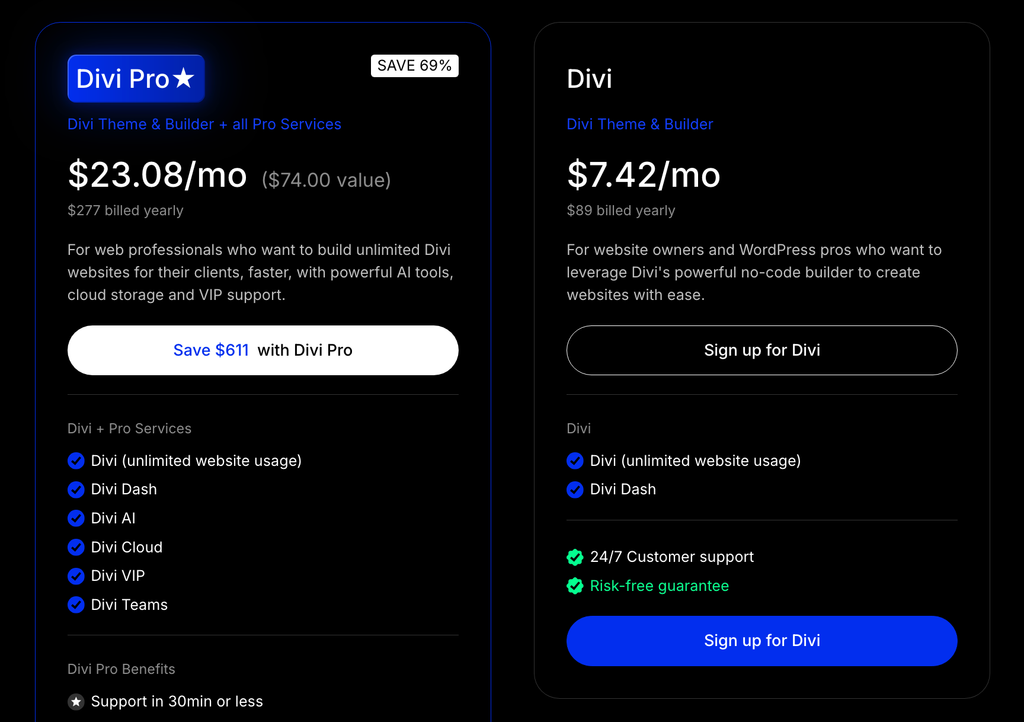
- Divi Yearly: $89/year
- Divi Lifetime: $249 one-time
- Divi Pro: $277/year, which adds Divi AI, Divi Cloud, and VIP support
Get 20% Discount on Elegant Themes!
Your membership also includes other Elegant Themes products like the Extra theme, Bloom, and Monarch.
If you plan to use Divi for more than a few years, the lifetime plan saves you a lot of money in the long run.
3. Beaver Builder
Beaver Builder has been around since 2014 and is known for stability and clean code. That’s why so many agencies trust it for client sites.
Interface
Beaver Builder uses front-end, drag-and-drop editing. You build directly on the page and see changes in real time.
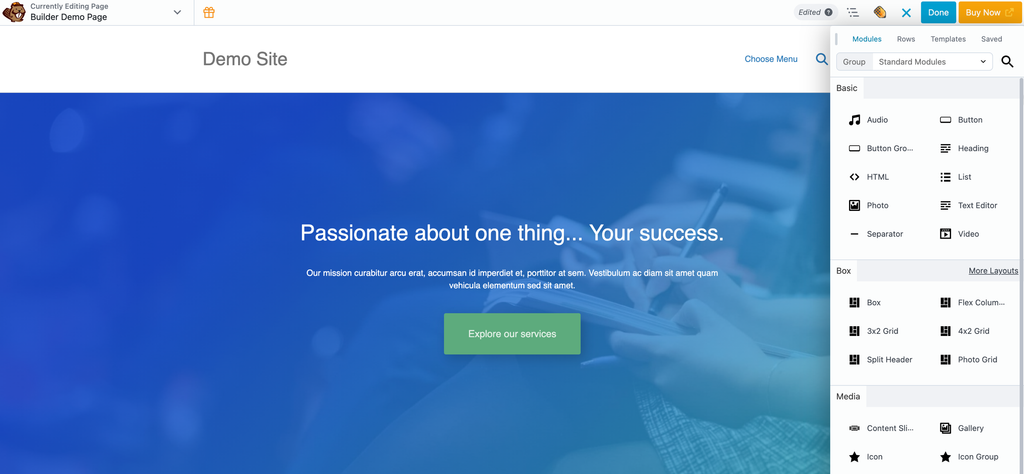
The interface isn’t as flashy as Elementor or Divi, but it’s clean and predictable. It has an outline panel for navigating complex layouts and a light and dark mode for the editor.
Widgets & Templates
Beaver Builder’s module library is smaller than Elementor’s, but it covers the essentials well, including pricing tables, forms, galleries, sliders, and icon groups. You also get a library of pre-built page templates.
If you need more modules, third-party add-ons like Ultimate Addons for Beaver Builder fill the gap.
Options
Every paid plan now includes the full suite: the Page Builder plugin, the Beaver Builder Theme, and Beaver Themer. Themer lets you design headers, footers, archives, and other theme parts.
The builder now includes responsive editing mode with custom breakpoints, so you can preview and adjust designs for tablets and phones. It also has conditional logic, dynamic content, and a Loop Builder.
The newest addition is Beaver Builder AI, which generates editable pages and sections right inside the builder.
Key Features
Here are some notable features of Beaver Builder:
- Front-end drag-and-drop editing
- Responsive editing with custom breakpoints
- Beaver Themer for theme templates
- Conditional logic and dynamic content
- WooCommerce support
- Global editing and saved templates
- Import and export of layouts
- Multisite support (Professional and Unlimited plans)
- White labeling (Unlimited plan)
Pricing
There’s a free Beaver Builder Lite version on WordPress.org. The premium plans are billed yearly:
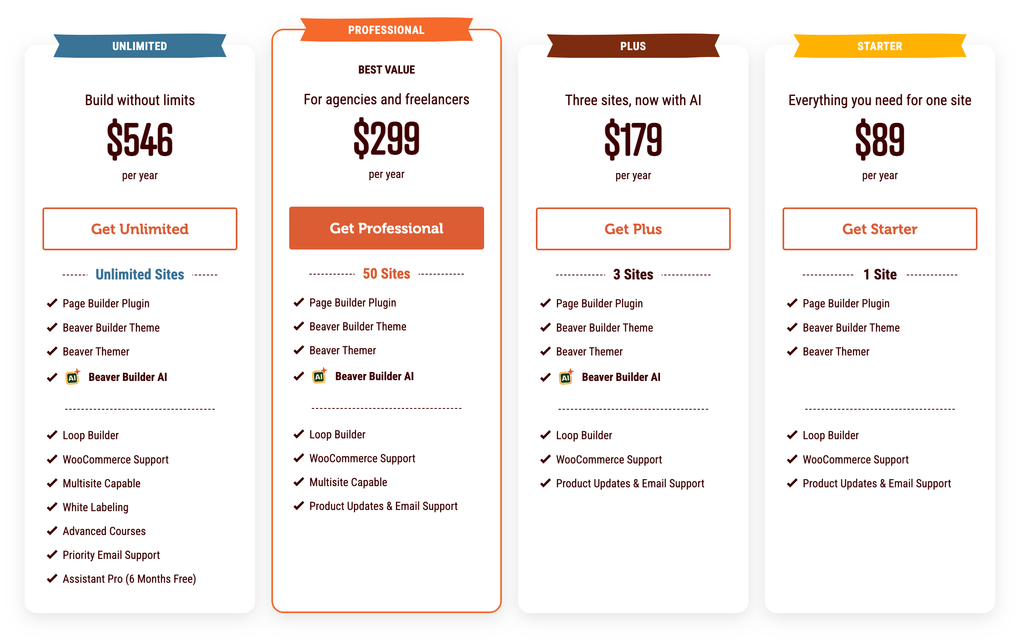
- Starter: $89/year for 1 site
- Plus: $179/year for 3 sites, includes Beaver Builder AI
- Professional: $299/year for 50 sites, adds multisite support
- Unlimited: $546/year for unlimited sites, adds white labeling and 6 months of Assistant Pro
Staging and development sites don’t count toward your site limit, which is handy for agencies.
4. CrocoBuilder
CrocoBuilder is an AI-native WordPress builder from Crocoblock, the team behind the popular JetPlugins. It’s built for developers, agencies, and creators who want the speed of visual building without giving up control over the code.
It’s a new product. It launched in beta in July 2026, and some features, like WooCommerce compatibility, are still on its roadmap. But its approach is different enough from traditional builders that it deserves a spot on this list.
Interface
CrocoBuilder combines a visual drag-and-drop editor with developer-oriented controls. You build pages visually while keeping direct control over the structure, styles, and code underneath.
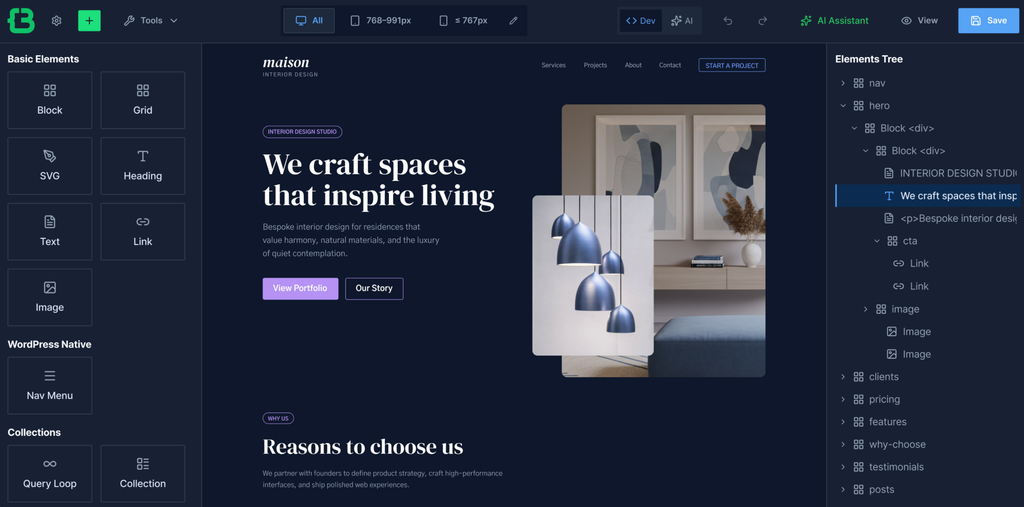
Its biggest difference is what it calls atomic DOM output. Each element you add in the builder becomes exactly one element in the page’s code. There are no hidden extra layers, so the page code stays clean and predictable.
It also has a unified styling panel where you manage classes, variables, and element styles in one place. You can switch between visual controls and raw CSS while working on the same styles.
Widgets & Templates
Instead of a fixed set of widgets, CrocoBuilder focuses on reusable components. The AI Component Builder lets you create custom components with HTML, CSS, and JavaScript, with editable properties and reusable slots.
For dynamic sites, the Loop Builder and Query Builder let you create dynamic layouts without writing PHP or SQL. Ready-made rich-content elements like tabs, sliders, and accordions are also included.
Options
CrocoBuilder controls your whole site, not just individual pages. The Theme Builder handles headers, footers, posts, archives, and other templates.
Its design system includes global styles, CSS variables, reusable classes, custom breakpoints, and CSS framework import and export. You can also show, hide, or change elements based on the user, the device, or other conditions.
Developer tools like CSS Sync, Web Components, and GitHub versioning help it fit into existing development workflows.
AI Features
CrocoBuilder builds AI directly into the website-building process. Its AI Assistant can generate pages, components, layouts, styles, and whole site structures from a prompt.
It also works with outside AI agents through MCP, including Claude Code, Gemini, Cursor, and GitHub Copilot Agent. You can review AI-generated changes before applying them, and the underlying HTML, CSS, and JavaScript stay fully editable.
Key Features
Here are some of the most notable features of CrocoBuilder:
- AI-assisted page and component creation
- Atomic DOM output for clean, predictable code
- Unified CSS controls, variables, and reusable classes
- Custom breakpoints and responsive controls
- Dynamic content with Loop, Query, and Theme Builders
- Reusable components with HTML, CSS, and JavaScript control
- Conditional logic and interactions
- MCP integrations with external AI tools
Pricing
CrocoBuilder doesn’t offer a free version, but it comes with a 30-day money-back guarantee.

- Custom Subscription: $79/year for 1 site or $179/year for unlimited sites. Includes the builder, AI-assisted workflows, 1 year of updates, and 1 year of Zoom and chat support.
- All-Inclusive Plus: $249/year for 1 site or $499/year for unlimited sites. Adds 23 JetPlugins and ready-made templates.
- Lifetime: $999 one-time. Includes 23 JetPlugins, the builder, templates, and lifetime updates and support.
If you already use JetPlugins, the All-Inclusive or Lifetime plans give you the most value.
5. Kirki
Kirki is a freeform visual builder from Themeum, the team behind Tutor LMS. It replaces WP Page Builder, Themeum’s older page builder, which is no longer available.
The name may sound familiar. Kirki started as a popular Customizer framework for theme developers. It has since been rebuilt into a full website builder (it was briefly called Droip) and combines both under one product.
Interface
Kirki works differently from most builders on this list. Instead of forcing you into rows and columns, it gives you an infinite freeform canvas. You can place elements anywhere, much like in a design tool such as Figma or Webflow.
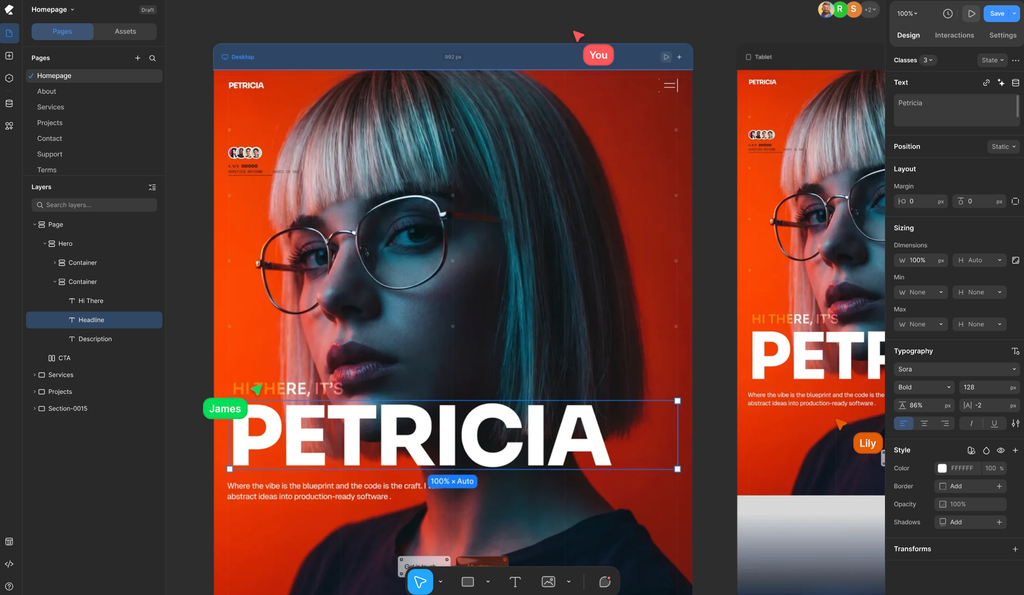
If you prefer structure, you can still use grids and layouts. A layers panel helps you keep complex designs organized.
Widgets & Templates
Kirki includes core elements and components, plus a built-in form builder, popup builder, and map element. The free version comes with 10 starter templates. Pro unlocks 100+ premium templates and a full library of pre-built sections in light and dark versions.
You can also import designs directly from Figma, with styles, spacing, and layouts preserved.
Options
Kirki has a surprising amount of power under the hood. Kirki CMS lets you create your own content types with custom fields and use them in dynamic templates.
The interaction builder and timeline editor let you create custom animations visually. It also includes an SEO panel, image optimization, and 20+ built-in apps that connect to tools like Mailchimp and Google Search Console.
Key Features
Here are some key features of Kirki:
- Infinite freeform canvas
- Responsive editing with unlimited breakpoints
- CSS variables and class manager
- Kirki CMS with custom fields and dynamic content
- Interaction timeline and text animations
- Built-in form and popup builders
- Figma to Kirki importer
- Real-time collaboration (Pro)
- Staging mode and publish history
Pricing
Kirki is free on WordPress.org with no limits on commercial use.
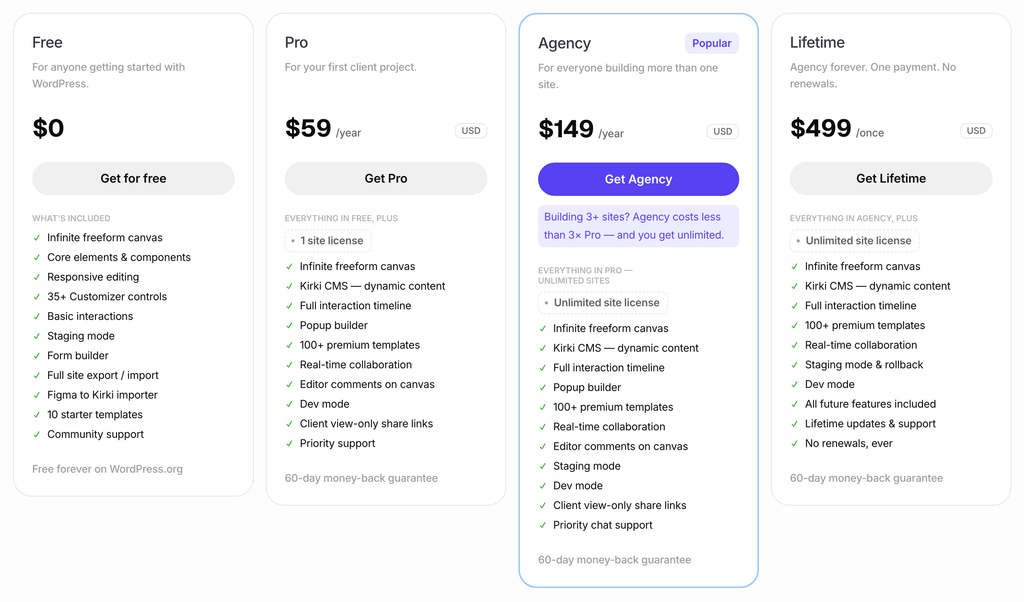
- Pro: $59/year for 1 site
- Agency: $149/year for unlimited sites
- Lifetime: $499 one-time, with unlimited sites and all future Agency features
All paid plans come with a 60-day money-back guarantee, which is longer than most builders offer.
6. Ultimate Blocks
Ultimate Blocks is a block plugin for the WordPress block editor (Gutenberg). This plugin is developed by us.
Technically, it’s not a page builder. But if you’d rather skip a page builder altogether and keep your site light, it adds many page builder style elements directly to the default editor. (Check: Gutenberg Vs Page Builders)
Interface
If you’re familiar with the WordPress block editor, you’ll have no trouble using Ultimate Blocks. You add blocks to your content just like you add the default WordPress blocks.
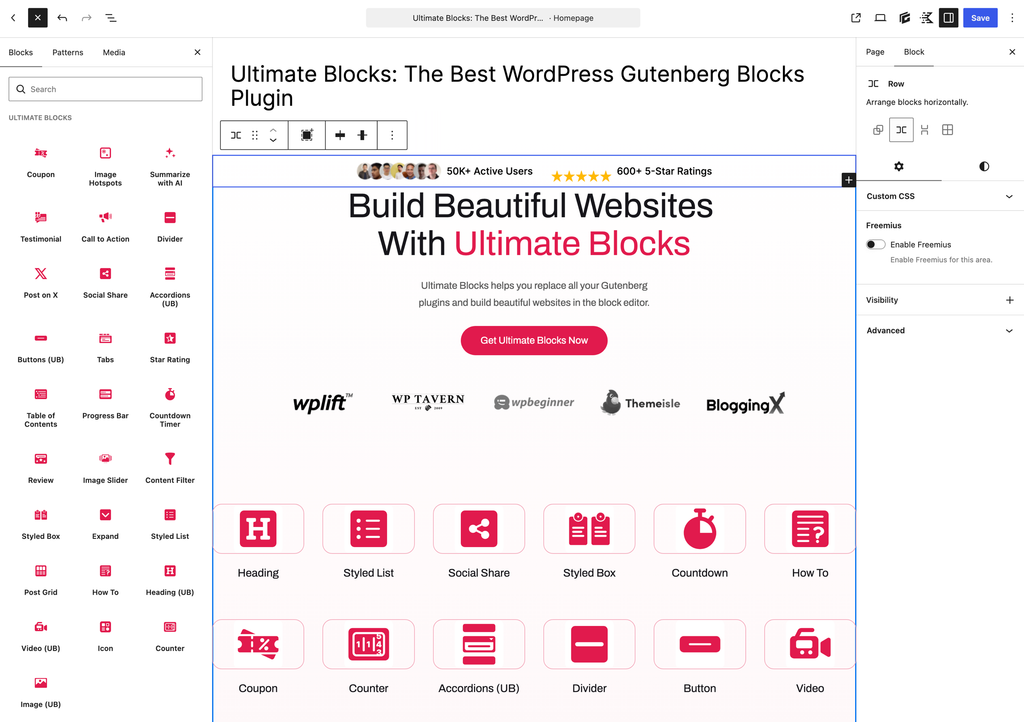
To edit a block, select it and customize it from the settings sidebar.
Widgets & Templates
Ultimate Blocks includes 28 blocks you can use to build richer pages and posts.
Some of the most popular blocks are:
- Accordions
- Table of Contents
- Tabs
- Review (with Schema)
- How To (with Schema)
- Content Filter
- Post Grid
- Call to Action
- Timeline (Pro)
- Image Hotspots (Pro)
You can see every block in action on our live demo page. We also run a free WordPress Patterns Library with ready-made patterns you can copy into your site.
Options
Each block comes with its own customization options for style, color, spacing, and layout.
Ultimate Blocks also adds four extensions to its blocks: Custom CSS, Responsive Control, Animation (Pro), and Visibility Control (Pro). Note that these extensions work on Ultimate Blocks blocks, not on core WordPress blocks.
Key Features
The plugin is lightweight and built to keep your pages fast. Since it works inside the default editor, there’s no extra builder layer on your site.
Here are some other notable features:
- Schema markup for Review and How To blocks
- Block manager to turn off blocks you don’t use
- Responsive controls for each block
- Works with any block theme or classic theme
Pricing
Ultimate Blocks is free on WordPress.org, and the free version includes most of the blocks.
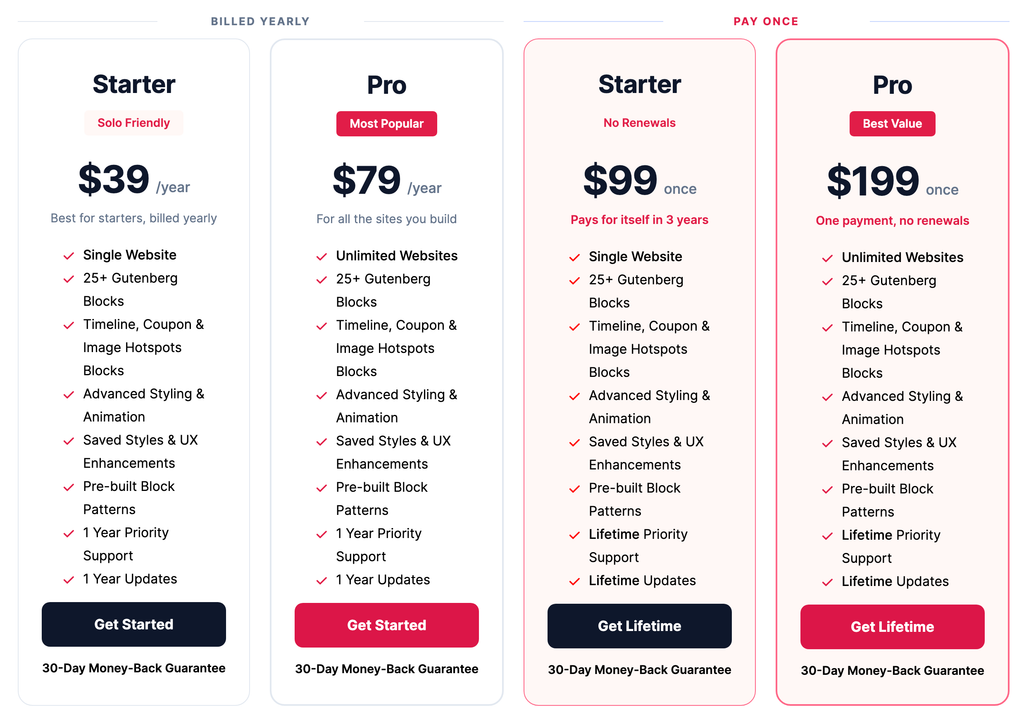
Ultimate Blocks Pro adds the Pro blocks and extensions:
- Starter: $39/year or $99 lifetime for a single site
- Pro: $79/year or $199 lifetime for unlimited sites
This plugin is perfect for anyone who wants page builder style elements without leaving the block editor.
7. Thrive Architect
Thrive Architect is a page builder by Thrive Themes that focuses on building conversion-optimized pages, like landing pages, sales pages, and opt-in pages.
Interface
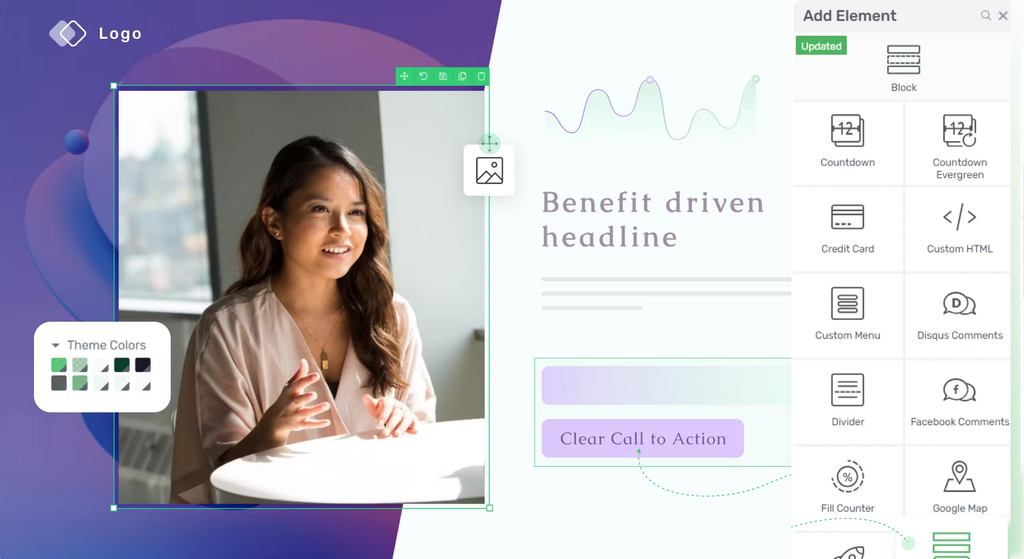
Thrive Architect’s interface is similar to Elementor’s. It’s a front-end, drag-and-drop editor that’s simple and intuitive to use.
Widgets & Templates
Thrive Architect comes with 300+ landing page templates and hundreds of pre-made page blocks.
The standard elements aren’t anything unique, but the templates are built around proven conversion principles and even come with guidance on what to write in each section.
Options
You get simple styling options for every element. You can hide elements on specific devices with a single toggle and adjust your design for mobile.
It also includes conditional display, so you can show different content to different visitors.
Key Features
Here are some important features of Thrive Architect:
- 300+ conversion-focused templates
- Hover effects and animations
- Flexible column layouts
- Conditional display
- Responsive editing
- Lead generation forms
- Integrations with email marketing services
- A/B testing (with Thrive Optimize)
Pricing
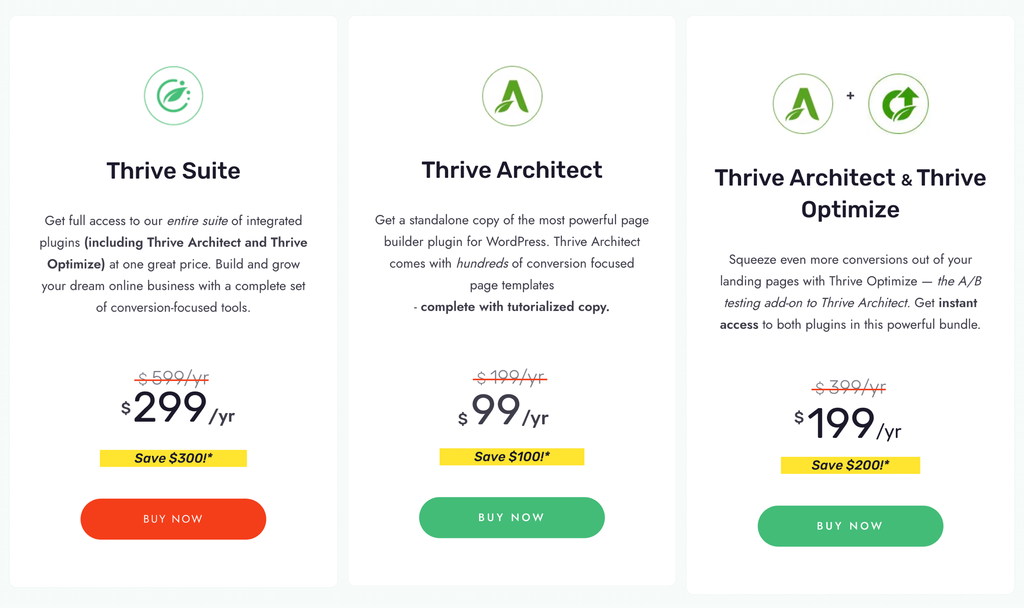
Thrive Architect is available as a standalone plugin. It costs $99 for the first year for one site, then renews at $199/year.
Other options:
- Architect + Thrive Optimize (A/B testing): $199 first year, then $399/year, for 1 site
- Thrive Suite: $299 first year, then $599/year, for up to 5 sites. Includes all Thrive plugins and Thrive Theme Builder.
One important thing to know: if your subscription expires, your pages keep working, but you can’t create or edit Thrive Architect content until you renew.
8. Visual Composer
Visual Composer is a drag-and-drop website builder with a what-you-see-is-what-you-get editor. (Don’t confuse it with WPBakery Page Builder, which used to share the same name. They’re now two separate products.)
Interface
The interface is minimal, so you’re not distracted by unnecessary panels while designing.
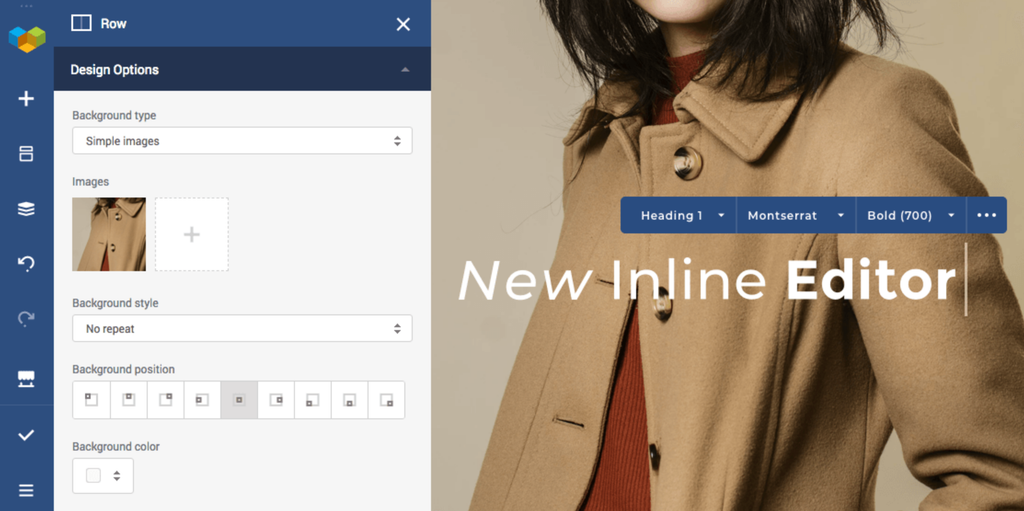
You drag elements onto the page and customize them directly. You can also switch between front-end and back-end editing.
Widgets & Templates
The premium version gives you 300+ content elements and 200+ templates through the Visual Composer Hub, a cloud library of elements, templates, and add-ons.
There are templates for individual sections, headers, footers, and full site layouts.
Options
Visual Composer offers plenty of customization options. You can add dynamic content, hide elements on certain devices, and use parallax, gradient, and video backgrounds.
It also includes shape dividers, animations, and image filters to spice up your designs.
Key Features
Here are some great features of Visual Composer:
- Visual Composer Hub (cloud library)
- Theme Builder for headers, footers, and sidebars
- Popup Builder
- Free Unsplash stock images
- Font Manager
- Dynamic content
- WooCommerce support
- Role Manager
Pricing
There’s a free version of Visual Composer with 30 elements and 10 templates.
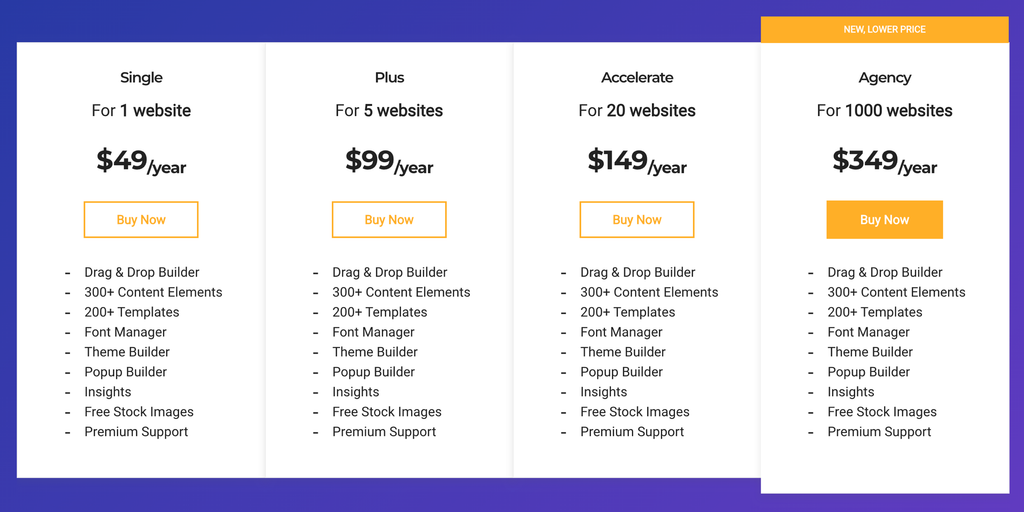
Premium plans are billed yearly:
- Single: $49/year for 1 site
- Plus: $99/year for 5 sites
- Accelerate: $149/year for 20 sites
- Agency: $349/year for 1,000 sites
There’s also a Lifetime plan at $149 for a single site, with lifetime updates and two years of support.
9. Themify Builder
Themify Builder is a page builder from Themify, a company that sells WordPress themes and plugins. It works with any theme, not just Themify’s own.
Interface
The interface isn’t the most modern, but it’s simple to use. You can drag elements onto the page and edit them.
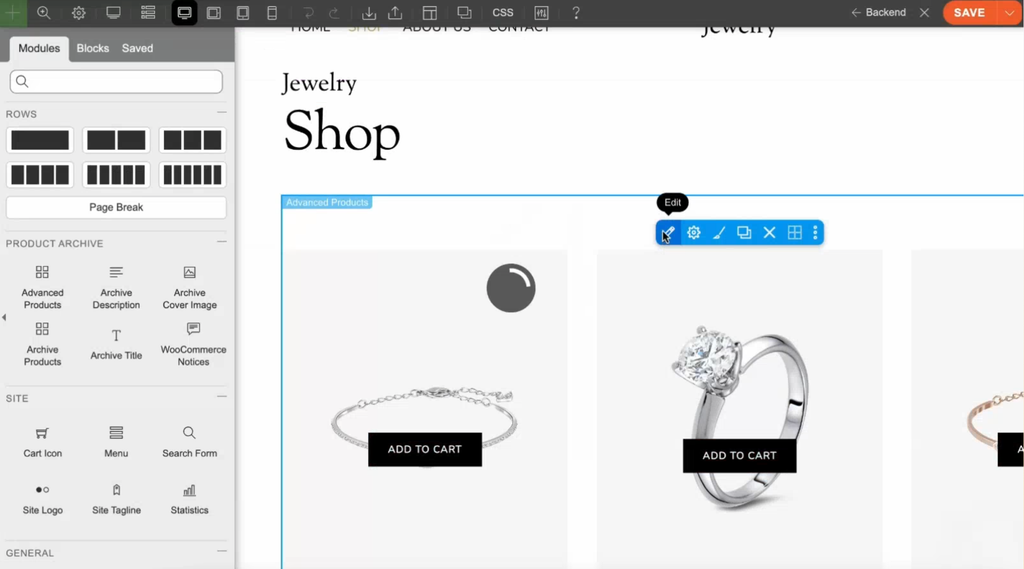
The builder lets you edit your pages both on the front end and in the WordPress admin.
Widgets & Templates
Themify Builder comes with a good set of modules and pre-designed layouts. Builder Pro adds 25 Builder Addons, including WooCommerce, contact forms, sliders, maps, pricing tables, timelines, and more.
Options
Themify Builder gives you plenty of styling options for elements and pages.
You can add slider backgrounds, video backgrounds, parallax scrolling, and animation effects.
With Builder Pro, you can also design custom templates for headers, footers, posts, archives, 404 pages, and WooCommerce shop and product pages, with display conditions to control where each template appears.
Key Features
Here are some important features of Themify Builder:
- Front-end and back-end editing
- Responsive design
- Animation effects
- Dynamic content from custom fields (ACF and more)
- Theme templates with Builder Pro
- WooCommerce templates
- Import and export of layouts
- Global styles
Pricing
Themify Builder is available for free.

Builder Pro costs $69/year and includes all 25 Builder Addons.
For better value, the Master Club ($89/year) or Lifetime Club ($249 one-time) gives you every Themify theme and plugin, including Builder Pro, for unlimited sites. Memberships don’t auto-renew, so you won’t be charged unexpectedly.
10. WPBakery Page Builder
WPBakery Page Builder is one of the oldest page builders for WordPress. It’s still bundled with many themes sold on ThemeForest, so you may already have it without buying it.
Interface
WPBakery offers both a front-end and a back-end editor.
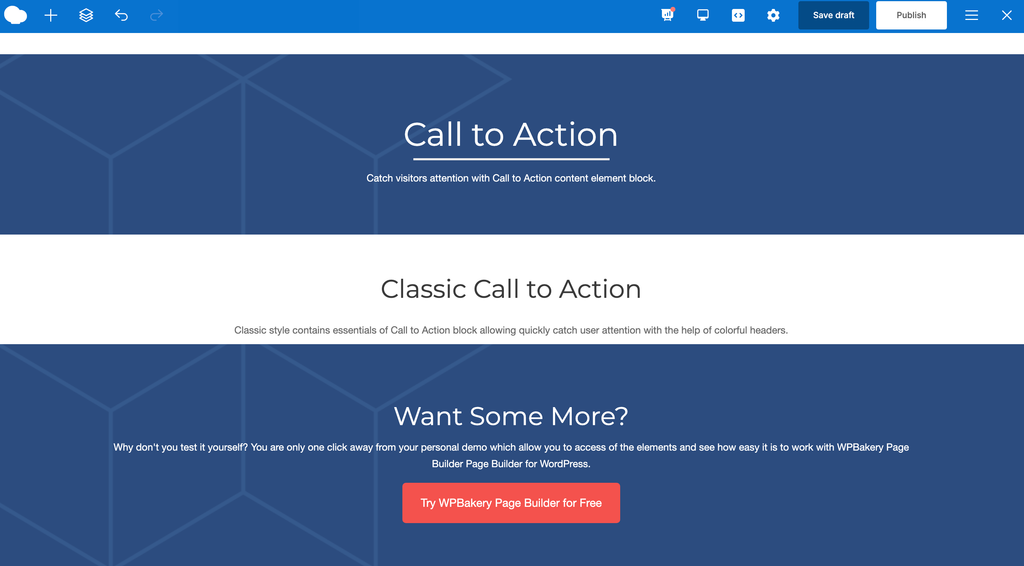
The front-end editor lets you drag and drop elements onto your page visually. The back-end editor is handy when you want to make quick structural changes without loading the full page.
Widgets & Templates
WPBakery includes a solid set of content elements, and hundreds of third-party add-ons are available to extend it.
It also comes with a template library you can use to design pages quickly, plus an advanced Grid Builder for post and portfolio layouts.
Options
You can customize both the layout and the style of every element. There are image filters, parallax effects, and a Skin Builder that lets you restyle the builder’s elements to match your brand.
Newer versions also include WPBakery AI and built-in SEO tools.
Key Features
Here are some of the best features of WPBakery:
- Front-end and back-end editors
- Advanced Grid Builder
- Template library
- WPBakery AI
- Skin Builder
- Works with most themes
- RTL support
- WooCommerce compatibility
One thing to keep in mind: WPBakery stores your layouts as shortcodes. If you ever switch builders, your pages will be left full of leftover shortcodes that need cleaning up.
Pricing
WPBakery has no free version, but you can try it in a free online demo.
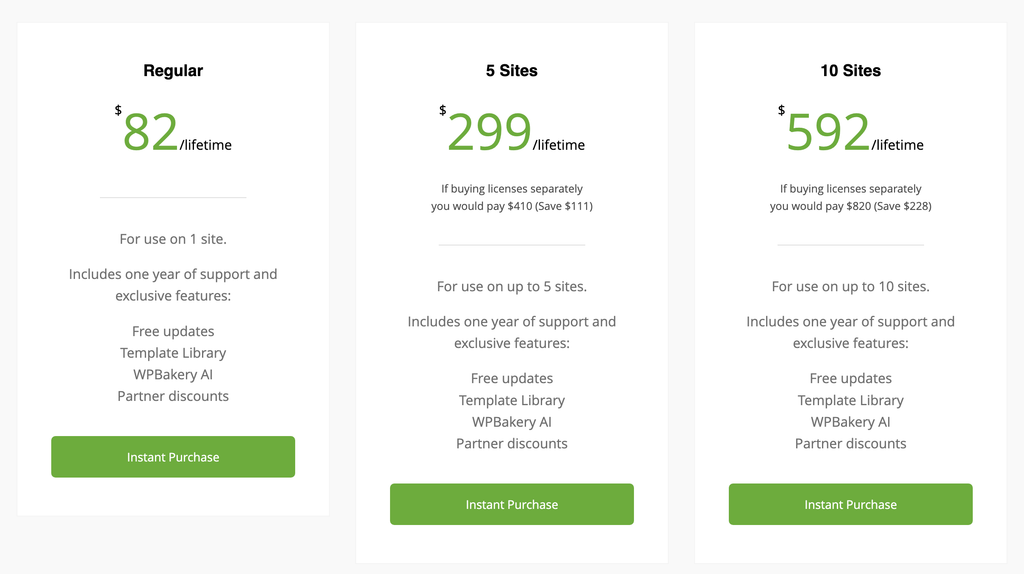
Its licenses are one-time payments:
- Regular: $82 for 1 site
- 5 Sites: $299
- 10 Sites: $592
Each license includes one year of Support Plus, which covers support, auto-updates, the template library, and AI features. After that, Support Plus costs $59/year. Manual updates remain available even if you don’t renew.
11. Page Builder by SiteOrigin
Page Builder by SiteOrigin is a free, lightweight page builder that has been around for more than 14 years. It’s a good pick if you want something simple that won’t slow your site down.
Interface
The builder uses a simple drag-and-drop editor where you add widgets and rows to your page.
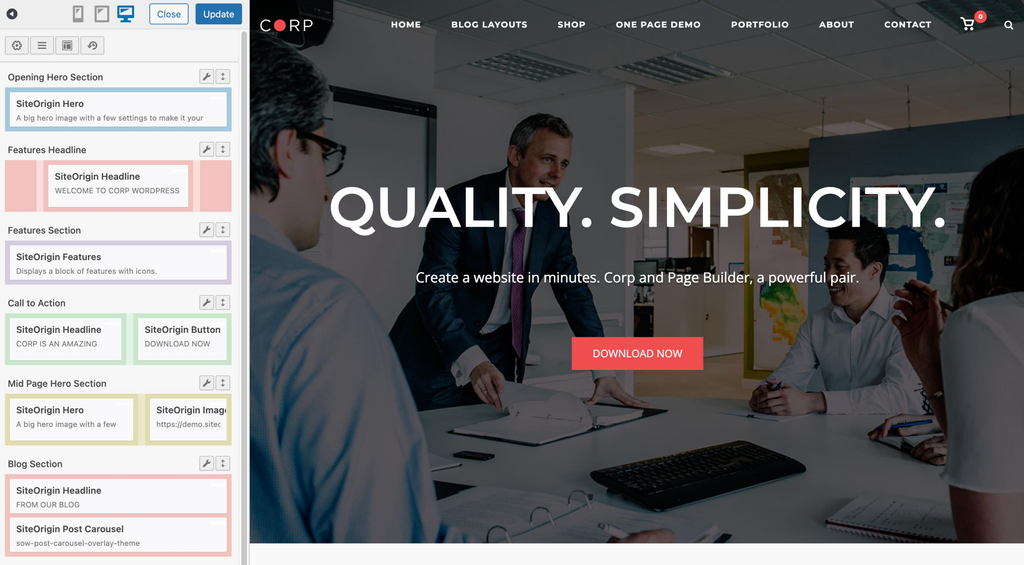
There’s also a live editor, so you can see your edits in real time without leaving the page.
Widgets & Templates
On its own, Page Builder includes only basic elements. Most users pair it with the free SiteOrigin Widgets Bundle, which adds widgets like buttons, sliders, image grids, and contact forms.
It also includes a library of pre-built layouts you can import as a starting point.
Options
The widgets come with basic customization and styling options, enough to build clean, simple pages.
SiteOrigin Premium adds 45 addons, such as parallax sliders, video backgrounds, animations, WooCommerce templates, and the ability to show or hide content by device.
Key Features
Here are the main features of SiteOrigin Page Builder:
- Live editor
- Responsive layouts
- Works with any theme
- History browser to undo changes
- Pre-built layouts
- Very lightweight output
It doesn’t have the design depth of Elementor or Divi, but its simplicity and speed are exactly why many developers still use it for client sites.
Pricing
Page Builder by SiteOrigin is free. SiteOrigin Premium unlocks all 45 addons plus priority support.
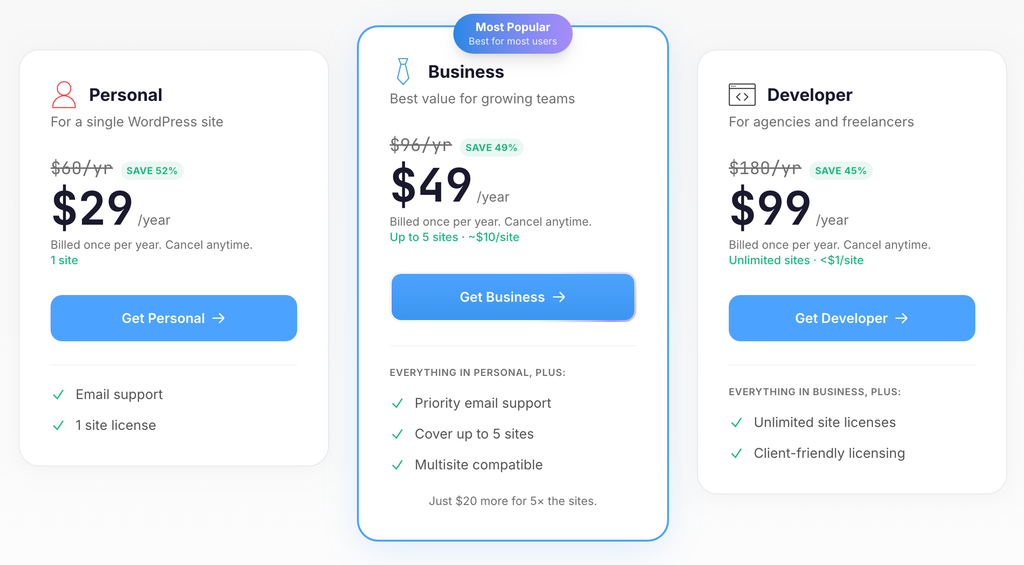
- Personal: $29/year for 1 site
- Business: $49/year for 5 sites
- Developer: $99/year for unlimited sites
Every plan includes a 60-day money-back guarantee.
FAQs
Is WordPress based on drag-and-drop?
Partly. The default WordPress Block Editor (Gutenberg) lets you add blocks, like paragraphs, images, headings, and lists, and rearrange them by dragging and dropping.
However, the Block Editor is focused on arranging content blocks. It doesn’t offer the same level of layout freedom and design control as dedicated page builders like Elementor, Divi, or Beaver Builder. Those tools give you a full visual canvas to build complete page layouts.
What is a Page Builder in WordPress?
A page builder is a WordPress plugin that gives you a visual, drag-and-drop interface for designing web pages without writing code.
You build layouts by dragging elements such as text, images, and buttons onto the page, then customize how they look and where they sit.
Do I need a Page Builder for WordPress?
It depends on your needs. If you want full design control with a drag-and-drop approach, a page builder is very helpful.
If your site is simple, the Block Editor combined with a block plugin like Ultimate Blocks may be all you need, and your site will stay lighter and faster.
Do page builders slow down your website?
Some can. Older builders often add extra layers of code to every page, which can affect loading speed. Newer builders, like Divi 5, Elementor’s V4 editor, CrocoBuilder, and Kirki, focus much more on clean, lightweight output. Good hosting and caching also make a big difference.
Can I use AI with a WordPress page builder?
Yes. Elementor, Divi, Beaver Builder, and WPBakery all offer AI features, usually on paid plans. CrocoBuilder is built around AI from the start and can work with outside AI tools like Claude Code and Cursor.
What is the best Page Builder for WordPress?
For most people, Elementor is the best WordPress page builder thanks to its huge feature set, free version, and ecosystem. Divi is the best value if you build many sites, especially with its lifetime plan. Developers who care about clean code should take a close look at CrocoBuilder or Kirki.
Conclusion
So these were the best page builder plugins for WordPress that can help you create beautiful pages without writing a single line of code.
To sum it up:
- Elementor is the best all-rounder for most people.
- Divi gives you the best value for unlimited sites.
- Beaver Builder is a reliable pick for agencies.
- CrocoBuilder and Kirki are exciting newer options for developers and designers.
- Ultimate Blocks is ideal if you’d rather stay in the block editor.
Now I want to hear from you:
Which page builder are you most interested in?
Let me know in the comments below!
Disclosure: This post contains affiliate links. That means if you make a purchase, we will get a small commission without any extra cost to you. Thanks for your support.


Leave a Reply